
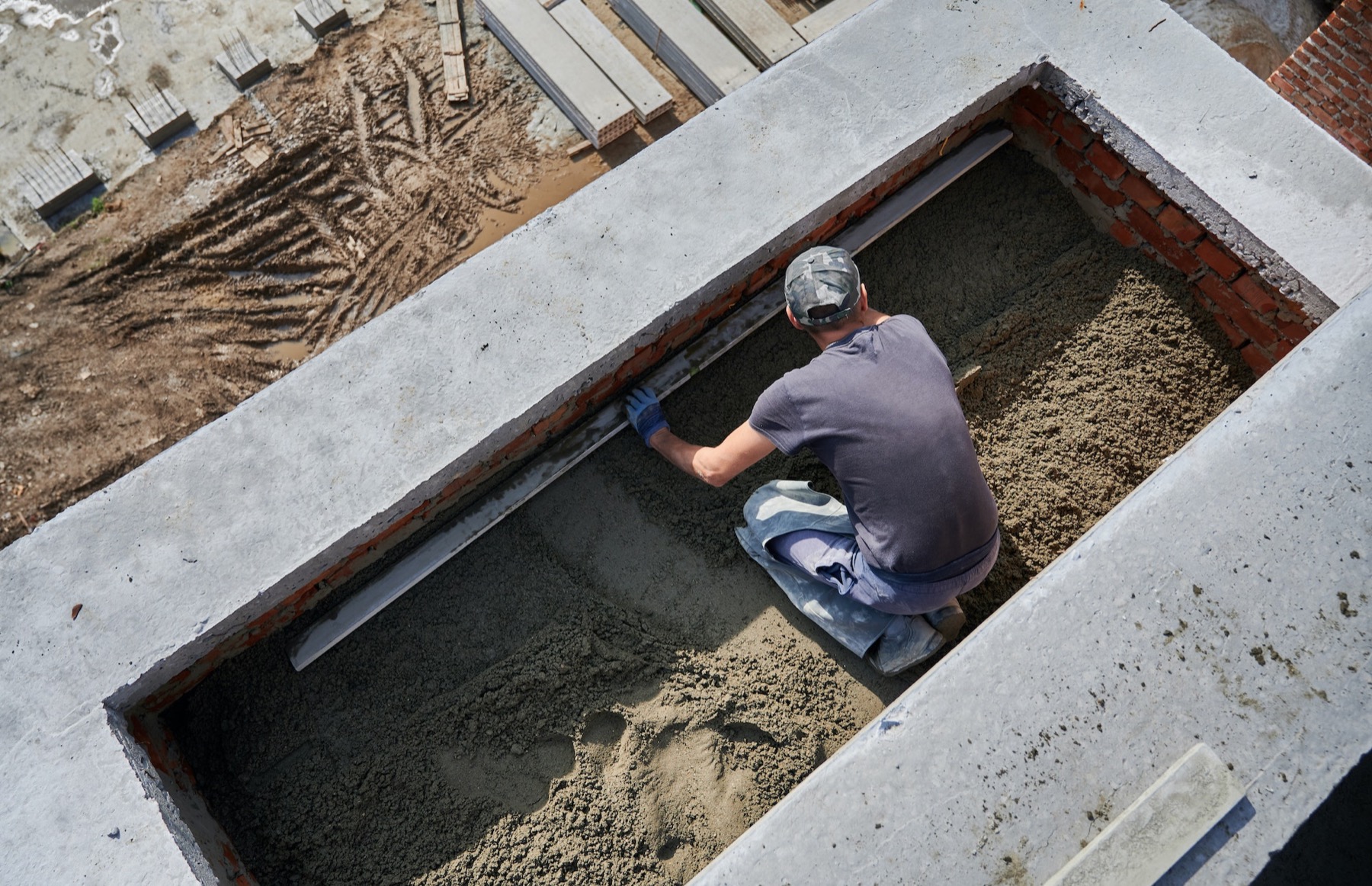
Screed is not concrete, and choosing between traditional and liquid changes your depths, your programme and how soon the floor finish can go down. We produce both from our dedicated screed plant at Tout Quarry.
What screed is for
A screed is a levelling layer laid over a structural base to give a smooth, accurate surface for the floor finish. It is not there to carry the structure — the slab underneath does that, and that slab is ready mixed concrete. Screeds are classified under BS EN 13813 and laid to BS 8204. See our floor screed page for what we produce.
Because it is a finishing layer rather than a structural one, a screed uses a finer aggregate than concrete and is laid far thinner. That is also why its drying time, not its strength, usually governs the programme.
Traditional sand and cement
A semi-dry mix, typically around four or five parts sand to one of cement, laid and compacted by hand and ruled off to level. It is the long-established method and it still suits a great many jobs.
- Bonded to the base: usually 25–40mm.
- Unbonded, over a membrane: 50mm or more.
- Floating, over insulation: around 65–75mm domestic, more under heavier loading.
- Over underfloor heating: usually 65–75mm, giving enough cover above the pipes.
It goes down at a slower rate than a pumped screed and depends heavily on the skill of the gang, but it is forgiving, it can be laid to falls, and it works in wet areas without special measures.
Liquid screed
Liquid, or flowing, screeds are pumped and self-compacting. They are laid several times faster than traditional, and they reach a flatter surface with less labour. We supply both families:
- Gyvlon — a calcium sulfate (anhydrite) binder.
- Cemfloor — a cement-based binder.
We batch both at the screed plant at Tout Quarry. Both can be laid thinner than traditional screed for the same job, which is where they earn their keep over underfloor heating: less depth above the pipes means the system responds faster and there is less mass to heat.
| Traditional sand & cement | Liquid screed | |
|---|---|---|
| Laying rate | Slower, hand-laid and ruled off | Much faster — pumped and self-levelling |
| Typical depth over underfloor heating | 65–75mm | Thinner for the same cover — confirm with the binder data sheet |
| Surface flatness | Depends on the gang | Consistently flat |
| Drying | Slow — see the rule below | Faster; Cemfloor generally quicker than anhydrite |
| Wet areas — bathrooms, wet rooms | Suitable | Cement-based yes; anhydrite is not suited to permanently wet conditions |
| Laitance | Not an issue | Anhydrite forms a surface laitance that must be removed before finishes |
| Adhesives and finishes | Straightforward | Anhydrite needs the right primer and a compatible adhesive |
| Laid to falls | Yes | No — it finds its own level |
Drying times, and the rule everyone quotes
The traditional guide is one millimetre a day for the first 50mm, slowing after that. On that basis a 75mm floating screed is not weeks away from being ready for a floor covering, it is months. It is the single biggest cause of programme slippage we hear about.
Liquid screeds dry faster, and cement-based liquid screeds faster again than anhydrite, but none of them are instant. Whatever you lay, the figure that matters is the residual moisture the floor covering will accept, and that has to be measured rather than assumed — usually with a hygrometer, to the method in BS 8203.
Drying also needs somewhere for the moisture to go. A sealed building with no ventilation and no heat will not dry a screed however long you leave it.
Underfloor heating and force drying
Underfloor heating can be used to speed drying, but not straight away and not quickly. The usual approach is to leave the screed to cure undisturbed for several days, then bring the flow temperature up in stages over a period of days, and back down again the same way. Ramping it up too early or too fast will crack the screed.
Follow the binder manufacturer’s commissioning schedule — it differs between products, and it is normally a condition of the guarantee.
Which one should you use
Traditional suits smaller areas, repairs and patching, floors that need to be laid to falls, wet areas, and jobs where a pump cannot realistically get to the floor.
Liquid suits large open floor plates, anything on a tight programme, and almost any underfloor heating installation, where the thinner section and better contact with the pipes both count.
If the floor has both — an open-plan ground floor with underfloor heating and a wet room off it — there is nothing wrong with using each where it fits. Tell the screed plant what the build-up is and they will tell you what they would put down.
Before you order
- The area and the depth, so we can work out the volume.
- The build-up — bonded, unbonded, floating, or over underfloor heating.
- Whether there is underfloor heating, and whose system it is.
- What the floor finish will be, since that sets the moisture target you have to hit.
- The access for a pump, and how far the pour is from where the truck can stand.
Our screed plant at Tout Quarry produces traditional, Gyvlon and Cemfloor screeds to BS EN 13813. Tell us the build-up and we will quote it.