
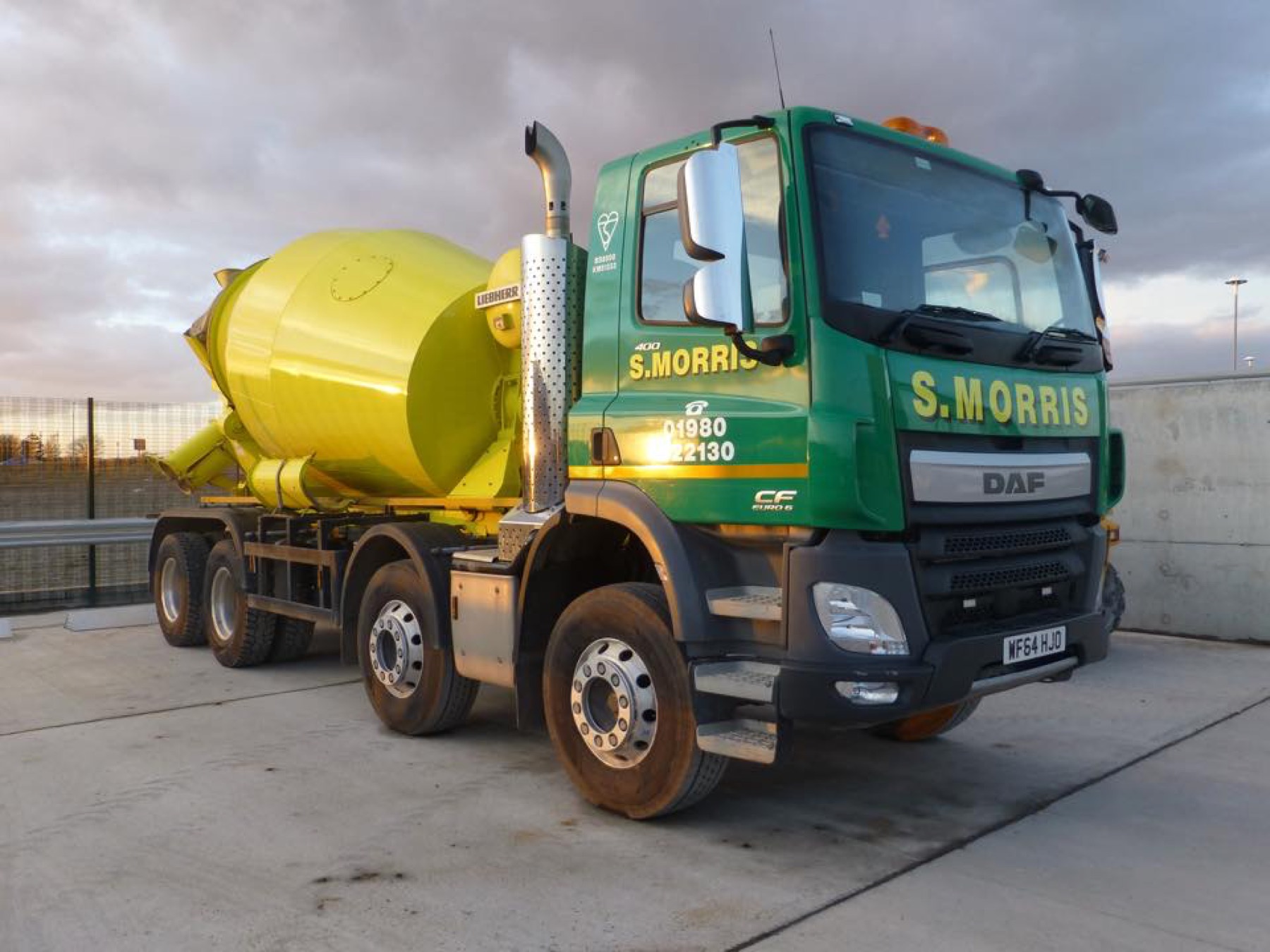
Ordering concrete starts with one question the plant will always ask: what is it going into? The answer decides the mix, and getting it right is the difference between a slab that lasts and one that spalls, cracks or fails an inspection.
This guide explains how concrete is specified in the UK, what the numbers mean, and which mix suits the jobs we are asked about most often. If you already know what you want, see our ready mixed concrete page or ring the plant that covers your postcode and they will price it.
How concrete is specified in the UK
Ready mixed concrete is produced to BS EN 206 and its UK complementary standard BS 8500. Between them they set out four ways of specifying a mix:
- Designated — the everyday route. You give a designation such as GEN3 or RC25/30 and the producer takes responsibility for meeting it. This is what most customers order.
- Designed — you specify the performance (strength class, exposure class, cement type) and the producer designs the mix to suit. Usual on engineered structures.
- Prescribed — you specify the actual constituents and proportions, and take responsibility for the result.
- Standardised prescribed — the ST range, for site-batched or simple work where a designated concrete is not required.
Unless you are working to a structural engineer’s specification, a designated concrete is almost always the right call. It puts the responsibility for the mix on us, and it is covered by our BSI quality assurance and our in-house testing. All our ready mixed concrete is batched to these standards, and the certificates are on our downloads page.
What C25/30 actually means
A strength class such as C25/30 gives two numbers, both in newtons per square millimetre, both measured at 28 days:
- 25 — the characteristic strength of a test cylinder.
- 30 — the characteristic strength of a test cube.
They describe the same concrete. UK practice quotes the cube figure, which is why you will hear a mix called “a 30 newton”. The word characteristic matters: it is the strength below which no more than 5% of results are expected to fall, not an average.
A common misunderstanding is that a higher number is always better. It is not. A stronger mix costs more, generates more heat, and shrinks more, which can mean more cracking on a large slab. The right mix is the one specified for the job.
Which mix for which job
The designations below are the ones we batch most often. Where ground conditions are aggressive, or where the concrete is reinforced, the specification should come from your engineer rather than from a table.
| Job | Usual designation | Notes |
|---|---|---|
| Blinding, mass fill, kerb backing | GEN1 | Unreinforced, non-structural. The cheapest mix we supply. |
| Strip footings and trench fill, non-aggressive ground | GEN1 | Check the ground first — see the note on sulfates below. |
| Foundations in sulfate-bearing ground | FND2 to FND4 | The class depends on the design sulfate class from a soil test. |
| Shed, garage and outbuilding bases | GEN3 | Unreinforced floor slabs. The everyday domestic base mix. |
| Domestic floor slabs, oversite | GEN3 | Add a damp-proof membrane below and fibres if you want to reduce shrinkage cracking. |
| Reinforced slabs, raft foundations, structural work | RC25/30 upward | Reinforced concrete classes run RC20/25 to RC40/50. Take the class from the drawing. |
| Driveways, paths and light hardstanding | PAV1 | Air-entrained for frost and de-icing salt resistance. Do not substitute a plain mix. |
| Yards and hardstanding taking HGVs or heavy plant | PAV2 | Air-entrained, higher strength. The usual choice for farm and industrial yards. |
| Agricultural slurry and silage storage | Designed mix | Needs a specified chemical resistance. Talk to the plant before ordering. |
| Covering electrical cables | Cement bound sand | Not concrete — see our cement bound sand page. |
Why air entrainment matters outside
PAV1 and PAV2 are air-entrained: microscopic bubbles are deliberately introduced into the mix. When water in the concrete freezes it needs somewhere to expand into, and those bubbles give it room. Without them, external paving exposed to frost and de-icing salt will surface-scale within a few winters.
This is the single most common specification mistake we see on domestic driveways. A GEN3 driveway will look fine in its first year and start pitting in its second or third. If it is outside, underfoot and exposed, order a PAV mix.
Consistence, and why you should not add water
Consistence — how wet and workable the concrete is — is specified as a slump class, usually S2 or S3 for general work. Tell the plant how you are placing it and they will batch the right one. A pour going through a conveyor or into a narrow trench wants a different consistence from one being tipped straight into an open base.
Adding water on site is the fastest way to weaken concrete. Water beyond the design amount raises the water-cement ratio, and strength falls off sharply — a small extra bucket in the drum can cost several newtons. It also increases shrinkage and surface dusting. If the load is not workable enough, say so before it is discharged rather than reaching for a hose.
Aggregate size and fibres
Twenty millimetre aggregate is standard. Ten millimetre is used where the section is thin, the reinforcement is congested, or the concrete is being pumped through a small line. It costs a little more and needs slightly more cement for the same strength.
Polypropylene fibres can be added to control early plastic shrinkage cracking, and steel fibres are used in some industrial floors as a partial replacement for mesh. Neither is a substitute for designed reinforcement. Ask the plant what is available for the mix you want.
What the plant needs from you
Five things, and the order takes about a minute:
- The volume in cubic metres. Our calculator works it out from your dimensions and adds 5% for wastage.
- What it is going into, so we can confirm the designation.
- The site postcode, which tells us which plant covers you.
- The access — whether an eight-wheeler can get to the pour, or whether you need a mini mix or a conveyor.
- The day you want it.
Orders are taken by the production plant, so you are talking to the people who batch it rather than a call centre.
Not sure which designation your job needs? Tell us what it is going into and we will confirm the mix and price it.